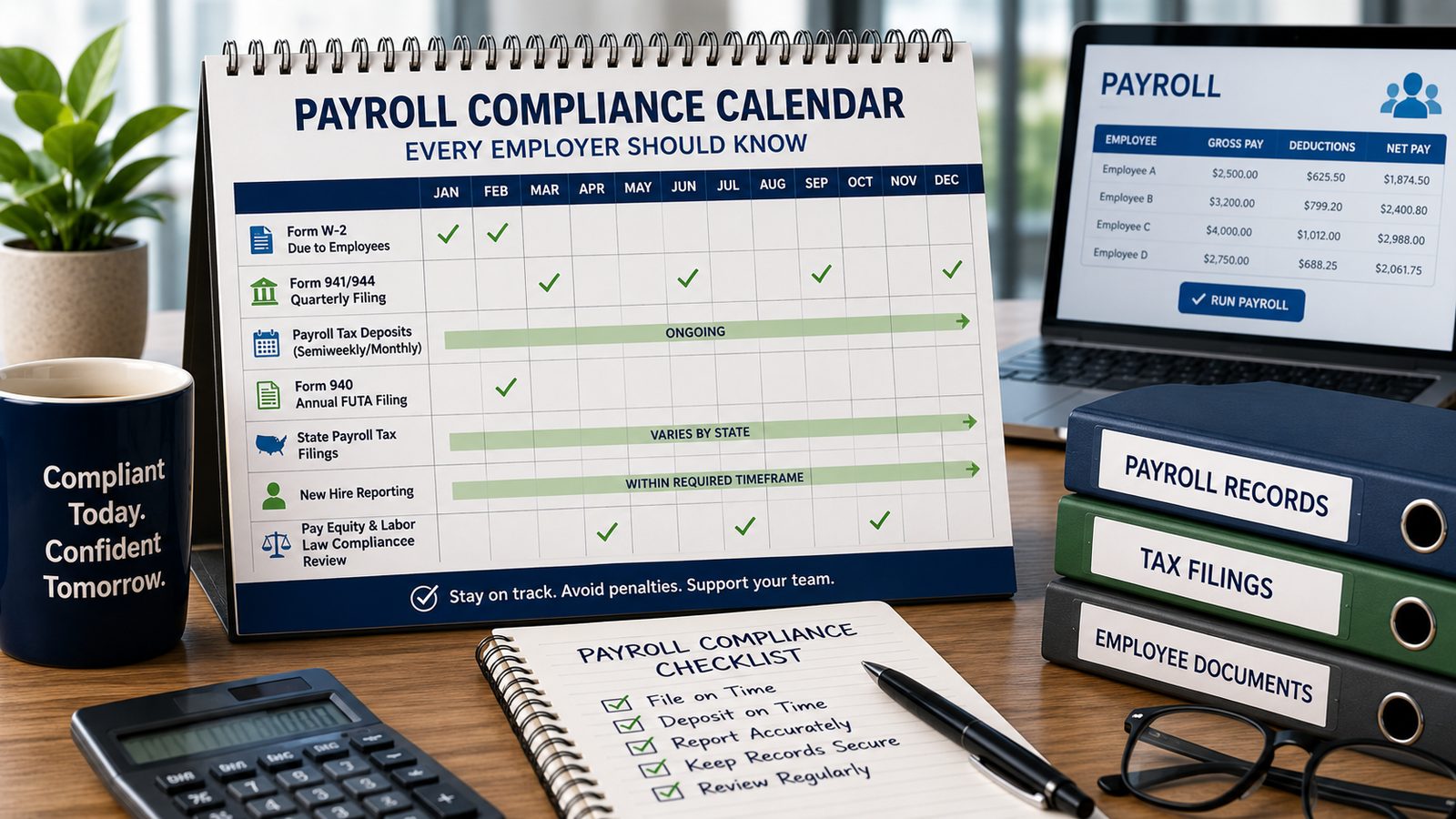
The moment you hire your first employee, you inherit a calendar. Federal tax deposits, quarterly returns, year-end forms — each with its own deadline and its own penalty for missing it. Here’s what that calendar looks like in plain English.
The recurring obligations
| Obligation | What it is | When |
|---|---|---|
| Payroll tax deposits | Withheld income tax plus Social Security and Medicare | Monthly or semi-weekly, based on your deposit schedule |
| Form 941 | Quarterly federal payroll tax return | Apr 30 · Jul 31 · Oct 31 · Jan 31 |
| Form 940 | Annual federal unemployment (FUTA) return | January 31 |
| W-2s to employees | Annual wage statements | January 31 |
| 1099-NEC to contractors | Nonemployee compensation statements | January 31 |
State obligations — unemployment insurance, state withholding, workers’ compensation — layer on top of the federal calendar and vary by state.
Where employers get hurt
- Deposit timing. The IRS penalty for late payroll deposits scales with how late you are — and it applies even if the return itself is filed on time.
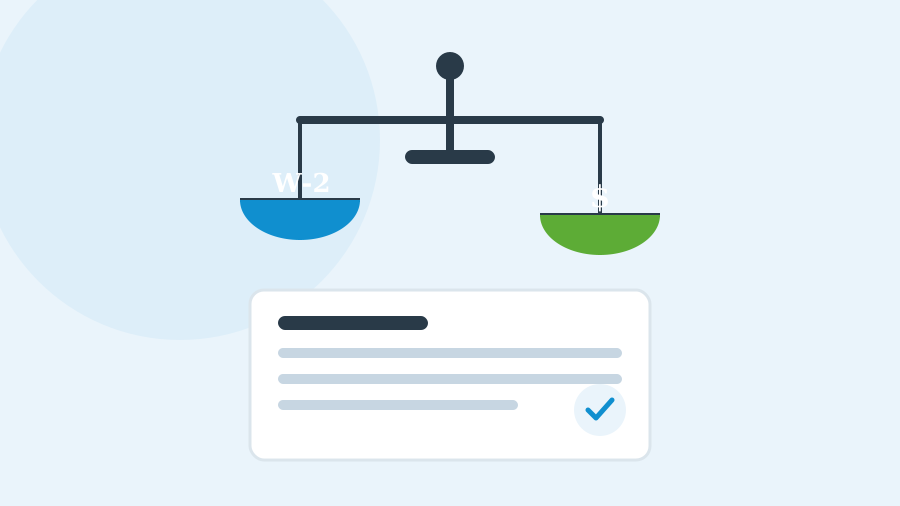
- Worker classification. Treating an employee as a contractor is one of the most expensive mistakes in small business.
- The trust fund trap. Withheld payroll taxes are the government’s money the moment you withhold them. Using them as working capital can create personal liability for owners — not just the business.
Payroll penalties are among the few that can reach past the business and land on the owner personally. That is what makes payroll different from every other bill you pay.
The simplest fix
Automate it, or delegate it. Every deadline above is predictable, which means every one of them is preventable. Our payroll clients never see this calendar — because we run it for them.