
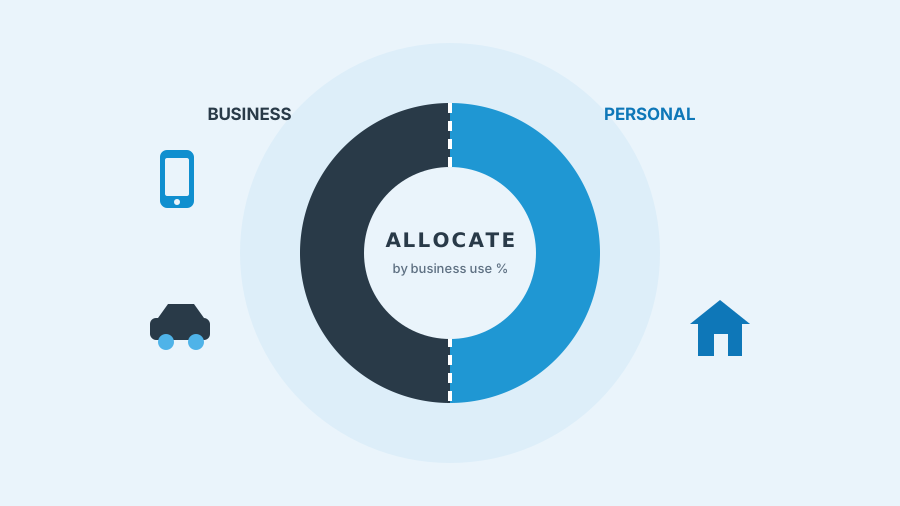
Some of the most common business deductions live in a gray zone: the car you also drive to the grocery store, the phone that rings for both clients and your kids, the spare bedroom that’s an office on weekdays. The IRS calls these mixed-use expenses, and they’re deductible — but only the business share, and only if you can prove it.
The one rule underneath all of them
Every mixed-use expense comes down to a single principle: you deduct the business-use percentage, and the personal portion is never deductible. Personal, living, and family expenses are explicitly non-deductible under the tax code. So the whole game is (1) determining the business percentage honestly and (2) having the records to back it up. Get those two right and these deductions are solid; guess at them and they’re exactly what an examiner pulls first.
The IRS scrutinizes mixed-use deductions more than almost any other category — not because they’re disallowed, but because they’re so easily overstated. Your records are the difference between a legitimate deduction and a disallowed one.
Your vehicle
The car is the classic mixed-use asset, and the most audited. You can deduct business use two ways: the standard mileage rate (72.5 cents per business mile for 2026) or the actual expense method (deducting the business-use percentage of gas, insurance, repairs, registration, and depreciation). You generally pick one approach and apply it consistently.
Two traps catch people every time:
- Commuting is personal, not business. Driving from home to your regular workplace doesn’t count — even if you take calls on the way. There’s an important exception: if your home qualifies as your principal place of business, trips from your home office to clients and job sites are deductible.
- A mileage log is required. The law requires a contemporaneous record — date, purpose, and miles for each business trip. Reconstructing a log after an IRS notice arrives is far weaker evidence than one kept as you go.
Your home office
A home office is deductible when the space is used regularly and exclusively for business — that word exclusively matters. The dining table you also eat at won’t qualify; a dedicated room or clearly defined area will. Once it qualifies, you deduct the business-use percentage of your home costs — if the office is 15% of your home’s square footage, roughly 15% of utilities, insurance, and similar costs become deductible (or you can use the IRS simplified per-square-foot method).
The hidden bonus, as noted above: a qualifying home office can turn otherwise-personal commuting miles into deductible business miles, since your commute now starts at your principal place of business.
Your phone, internet, and computer
Same principle, smaller dollars: if you use your cell phone or home internet for both business and personal purposes, you deduct only the business percentage — a reasonable, defensible estimate of how much of the use is for the business. The days of writing off 100% of a phone that’s obviously also personal are over. Pick a percentage you could explain to an examiner with a straight face, and be consistent.
Travel that mixes business and pleasure
Combining a conference with a few vacation days is fine — the IRS just requires you to allocate. For travel within the U.S., the primary purpose test governs the big-ticket item: if the trip is primarily for business (more business days than personal), your transportation — the airfare to get there and back — is generally fully deductible. The day-to-day costs, though, get split: lodging and 50% meals on business days are deductible; the days you spend sightseeing are not. Flip the ratio so the trip is primarily personal, and the airfare itself stops being deductible.
What the IRS wants if you’re audited
Across every mixed-use expense, the substantiation requirement is the same set of elements: the amount, the time and place, the business purpose, and — for the business-use percentage — the records that support how you split it. Practical habits that hold up:
- Keep a real mileage log (an app that tracks trips is ideal)
- Save receipts for actual-expense items, not just the total
- Document how you arrived at each percentage — square footage for the office, a usage estimate for the phone
- Keep records for at least three years after filing; longer is safer
A credit-card statement proves you spent money, not that it was for business. The “why” and the “how much was business” are what carry the deduction — and they’re nearly impossible to reconstruct convincingly a year later.
The bottom line
Mixed-use deductions are legitimate and valuable — the vehicle, the home office, the phone, the working trip all belong on the return when there’s real business use behind them. What makes or breaks them is the percentage and the paperwork. This is general information rather than advice for your specific situation, and the right treatment depends on your entity type and facts — but building the systems that capture these correctly all year, so the deduction is there and defensible at filing time, is exactly what we do for the businesses we work with.