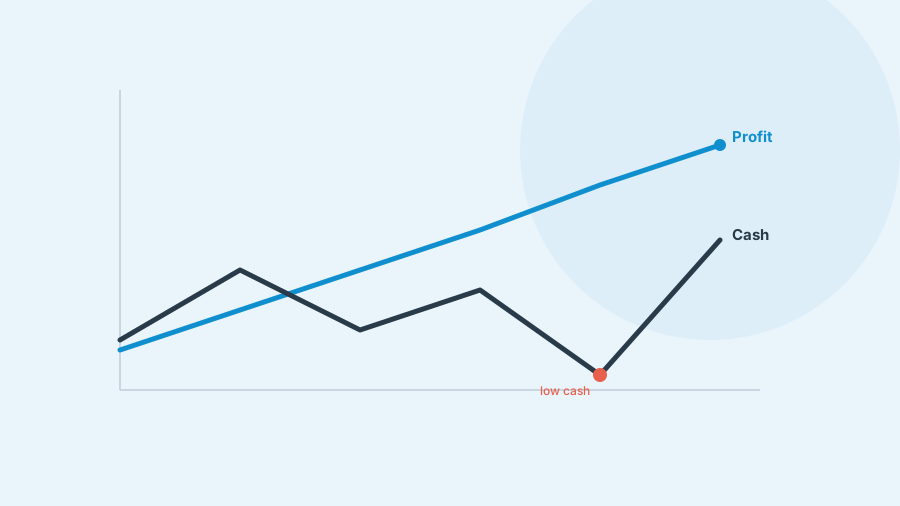
Here is a scenario that catches business owners off guard every year: your profit and loss statement shows a solid profit, your accountant confirms you owe tax on it — and yet your bank account is nearly empty. How can you be profitable and broke at the same time? The answer is the single most important distinction in small business finance: profit and cash are not the same thing.
Two different questions
Profit and cash flow answer two different questions about your business. Profit asks: over this period, did what I earned exceed what I spent? It lives on your profit and loss statement. Cash flow asks: how much money actually moved in and out of my bank account? Those sound like the same thing, but they come apart constantly — and the gap between them is where businesses get into trouble.
Profit is an opinion; cash is a fact. A business can show a profit on paper for months while quietly running out of the money it needs to operate.
Why a profitable business runs out of money
Several everyday things create profit without creating cash — or burn cash without touching profit:
- Unpaid invoices. When you invoice a client, your P&L records the income immediately — but the cash doesn’t arrive until they pay, which might be 30, 60, or 90 days later. You’re “profitable” on work you haven’t been paid for.
- Inventory. Money spent stocking up isn’t an expense on your P&L until the goods sell — but the cash left your account the day you bought it.
- Loan payments. The principal portion of a loan payment isn’t an expense on your P&L, but it absolutely leaves your bank account every month.
- Equipment purchases. Buy a $30,000 vehicle and the cash is gone now, but the P&L may only recognize it slowly through depreciation.
- Owner draws and taxes. Money you take out, and money set aside for taxes, reduces your cash without ever appearing as a business expense.
Every one of these widens the gap between “we made money” and “we have money.”
The report most owners never look at
Your P&L tells you if you’re profitable. Your cash flow statement tells you where the money actually went — how profit turned (or didn’t turn) into cash in the bank. It’s the third core financial statement, alongside the P&L and the balance sheet, and it’s the one small business owners most often ignore. Reading it is how you catch a cash squeeze coming before it arrives, instead of discovering it when a payment bounces.
What to actually do about it
- Watch cash and profit separately. Don’t assume a profitable month means a comfortable bank balance. Look at both.
- Manage receivables. Invoice promptly, follow up on late payers, and consider deposits or faster terms. Uncollected invoices are the number-one cash killer.
- Keep a cash cushion. A reserve that covers a few months of operating costs turns a cash-timing problem from a crisis into a non-event.
- Plan for the non-P&L drains. Loan principal, taxes, and owner draws are predictable — budget for them even though they don’t show up as expenses.
The bottom line
Profit is the score at the end of the game; cash flow is whether you can keep playing. A growing, profitable business can still fail if it runs out of cash — and plenty have. Understanding the difference, and watching both numbers, is one of the highest-leverage financial habits an owner can build. Helping business owners see both clearly — and set up the reporting that keeps cash surprises from happening — is a core part of what we do.